Why Your Jacket Sleeves Are the First Thing People Notice
Quick Answer: A jacket sleeve should end at the wrist bone with arms relaxed at your sides - roughly where your hand meets your wrist, revealing about a centimetre of shirt cuff if you are wearing one. Standard sizing typically drafts sleeves for a woman around 165 cm, so at 178 cm and above the sleeve often lands two to five centimetres short, which the eye reads instantly as ill-fitting even when it cannot name why. Buying tall-specific outerwear or having sleeves lengthened from the shoulder seam are the only two real fixes.
You can get away with trousers that are slightly short by calling them cropped. You can get away with a top that is slightly short by calling it a hemline. There is no name that rescues a sleeve ending three centimetres above your wrist - it reads as a jacket that belongs to someone else, and it does so from across a room.
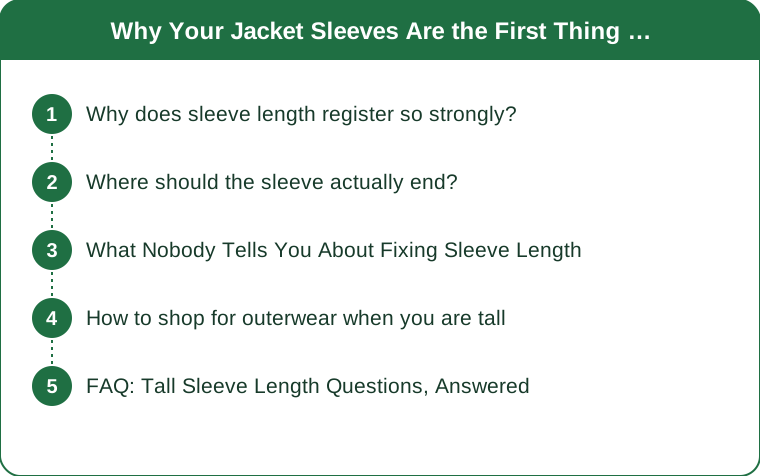
Why does sleeve length register so strongly?
Because of where hands sit in the visual field and how the eye reads edges.
Hands are one of the most looked-at parts of a person, after the face. In conversation, gesture, and photographs, hands are constantly in view. Anything that frames them - a cuff - is being looked at continuously, whether or not anyone is conscious of it.
A hem creates a horizontal line, and the eye locks onto it. A sleeve that ends mid-forearm creates a strong horizontal in the middle of a limb, which visually shortens the arm and interrupts the vertical line that good tailoring is built on.
The wrist bone is a natural landmark, and the eye seems to expect an edge to relate to it. Ending exactly at it looks intentional. Ending two centimetres above it looks accidental, because there is no anatomical reason for an edge to be there.
Proportional consistency is what reads as expensive. When the shoulder seam, the sleeve, and the body length all relate correctly to the wearer, the garment looks made for them. When the shoulder fits and the sleeve is short, the mismatch is precisely what signals off-the-rack compromise.
And sleeves move. Raise your arm to reach a shelf and any sleeve rides up several centimetres. A sleeve that is already at its limit standing still becomes obviously short in motion, which means the problem appears repeatedly through the day rather than once in the mirror.
One extra factor tall women deal with specifically: arm length and height are correlated but not proportionally identical. Two women of the same height can need noticeably different sleeve lengths, which is why height-based sizing charts help but do not solve the problem alone.
Where should the sleeve actually end?
There is a standard, and it varies by garment type.
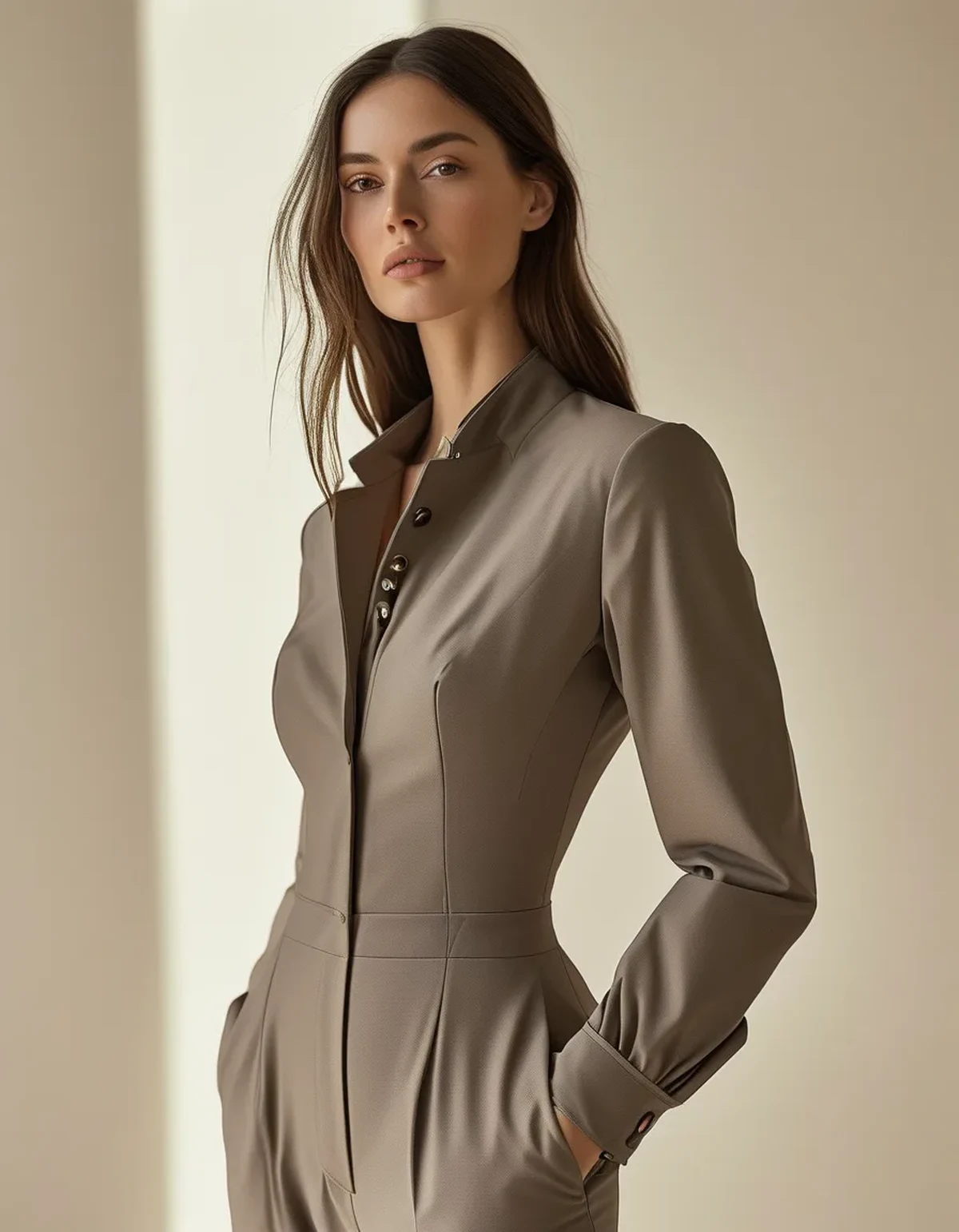
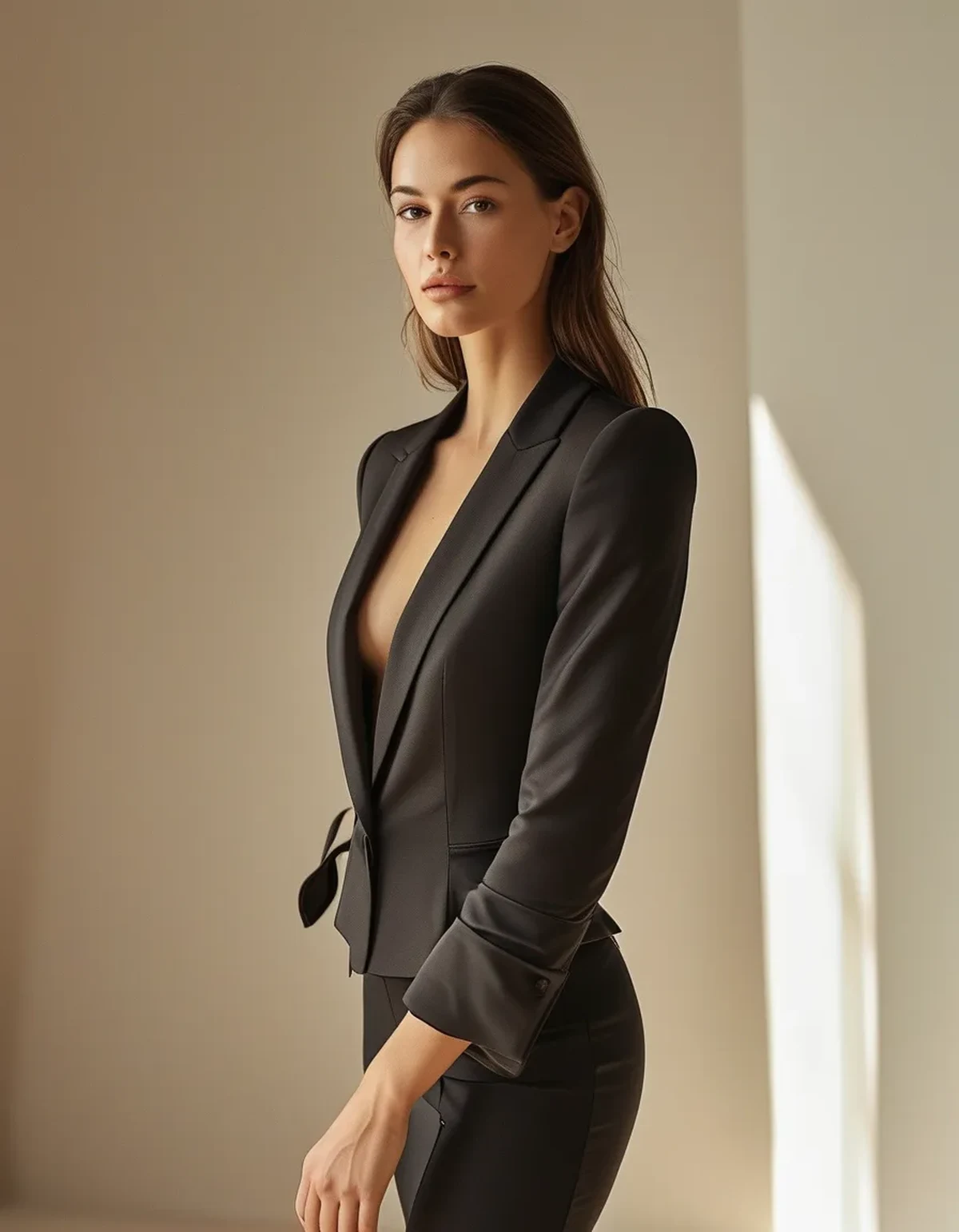
Tailored jacket and blazer: at the wrist bone, with roughly one to one and a half centimetres of shirt cuff showing beneath. This is the classic rule and it holds well.
Coat and overcoat: slightly longer, reaching the base of the thumb joint. A coat sleeve is meant to cover more, because it is worn over other sleeves and in colder conditions.
Casual jacket, denim jacket, bomber: at the wrist bone or marginally beyond, with the cuff sitting on the wrist rather than above it.
Long-sleeve knit and shirt: at the wrist bone, or slightly longer if the design intends a half-covered hand.
How to check properly. Stand relaxed with arms at your sides - not held stiffly, not reaching. Sleeves ride up if you hold your arms even slightly forward, which is exactly what people do when checking in a mirror, producing an optimistic reading. Better still, have someone photograph you from the front with arms relaxed, because a photograph is honest in a way a mirror is not.
Then test the dynamic version. Reach forward as if for a door handle. The sleeve will ride; the question is whether it rides to short or merely to shorter. A correctly fitted sleeve still covers most of the wrist when reaching.
And the tolerance is smaller than people assume. A centimetre either side of correct is invisible. Two centimetres reads as slightly off. Three centimetres or more reads as wrong, and no styling compensates.
Sizing up is not the fix, and this is worth stating plainly. Going up a size adds sleeve length, but it also adds shoulder width, chest room, and body width - typically a couple of centimetres of sleeve for a shoulder seam that now sits halfway down your upper arm. A dropped shoulder seam is a more visible fit failure than a short sleeve, so this trade almost never comes out ahead.
What Nobody Tells You About Fixing Sleeve Length
Most jackets have almost no lengthening allowance at the cuff. People assume a tailor can simply let the sleeve down. Typically there is one to two centimetres of turn-back inside the cuff, sometimes less, and on a lined jacket the lining limits it further. If you need three or more centimetres, the cuff hem cannot provide it.
The real fix is lengthening from the shoulder seam, which is a genuine tailoring operation - the sleeve is detached, a matching section is inserted or the sleeve cap is recut, and the whole thing is reset. It works beautifully and it costs accordingly. On a good coat it is worth it; on a fast-fashion jacket it will cost more than the jacket.
Buttoned cuffs complicate everything. Working buttonholes on a jacket cuff mean lengthening from the cuff is effectively impossible without recutting the entire lower sleeve. Check for functional buttonholes before buying anything you intend to alter.
Sleeve heads and shoulder pads make shoulder-seam work skilled labour. A structured jacket has internal construction at the sleeve cap that has to be rebuilt correctly, or the sleeve will hang wrong afterward. Ask specifically whether the tailor has done sleeve-cap lengthening on structured outerwear before.
Push-up sleeves are a real design solution, not a compromise. A jacket designed to be worn with sleeves pushed to the forearm - soft, unstructured, often unlined - sidesteps the whole problem, because the sleeve is intentionally not ending at the wrist. This is the single most useful category for a tall woman shopping non-tall ranges.
And the industry standard you are fighting is roughly 165 cm. Standard womenswear grading typically drafts to that height and then grades sizes by width more than by length. That is why sizing up adds so much width for so little length - the grade was never designed to add height. Tall ranges are drafted differently from the start, with longer sleeves, higher armholes, and longer bodies, which is why a tall-range jacket in your normal size usually fits better than a standard-range jacket two sizes up.
How to shop for outerwear when you are tall
Practical, in order of effectiveness.
1. Buy from tall ranges first, always. They are drafted rather than adjusted, and the sleeve, body, and armhole all move together. The selection is smaller, so buy when you find something rather than when you need it - especially outerwear, which is seasonal and sells out.
2. Measure your own sleeve length once and write it down. From the shoulder point, over a slightly bent elbow, to the wrist bone. Then measure a jacket you already own that fits. Those two numbers turn online shopping from a lottery into arithmetic, because many retailers publish sleeve measurements.
3. Favour dropped-shoulder and oversized cuts. A dropped shoulder has no defined seam point that has to align with your shoulder, which removes the main constraint and effectively lengthens the sleeve.
4. Favour unstructured over structured. Soft-shouldered jackets can be pushed up, rolled, and worn intentionally short in a way a structured blazer cannot.
5. Treat three-quarter and bracelet sleeves as an ally. A sleeve designed to end at mid-forearm is correct at mid-forearm on anyone. The failure mode is only when a full-length sleeve lands there by accident.
6. Layer with intent. A long shirt cuff or a thin knit sleeve deliberately extending past a slightly short jacket sleeve reads as considered layering rather than a fit problem. This works best when the under-layer is an obvious contrast, so it is clearly a choice.
7. For anything expensive, budget for alteration. A well-made coat lengthened at the shoulder by a competent tailor is a garment you keep for a decade. That is a much better purchase than three cheaper coats that never quite fit.
8. Check the armhole height, not just the sleeve. Tall frames often need a higher armhole, and a low armhole restricts arm movement and drags the whole jacket when you reach. It is the fit detail nobody mentions and it makes an enormous difference to how a jacket feels to wear.
FAQ: Tall Sleeve Length Questions, Answered
Where should a jacket sleeve end?
At the wrist bone with your arms relaxed at your sides, showing about a centimetre of shirt cuff beneath. Coats run slightly longer, to the base of the thumb joint. Check it in a photograph rather than a mirror, because people unconsciously hold their arms forward when checking, which makes sleeves look longer than they are.
Can a tailor make jacket sleeves longer?
Sometimes, but usually not by much from the cuff - most jackets have only one to two centimetres of turn-back allowance, and functional buttonholes remove even that. The reliable fix is lengthening from the shoulder seam, which means detaching and resetting the sleeve. It works well, but it is skilled work and priced accordingly.
Should I size up to get longer sleeves?
Generally no. Standard grading adds much more width than length per size, so you gain a couple of centimetres of sleeve while the shoulder seam drops down your upper arm. A dropped shoulder seam is a more visible fit failure than a short sleeve, so the trade usually makes the jacket look worse rather than better.
Why are standard sleeves too short if my arms are normal for my height?
Because standard womenswear is typically drafted for a woman around 165 cm and then graded mainly by width. Your arms are proportionally normal - the pattern simply was not made for your height, and sizing up does not fix a length problem with a width solution.
What jacket styles work best if sleeve length is the issue?
Dropped-shoulder cuts, unstructured soft jackets designed to be pushed up the forearm, and anything with an intentional three-quarter or bracelet sleeve. All three remove the requirement that a sleeve end precisely at the wrist, which is the constraint causing the problem in the first place.
TL;DR:
- Wrist bone with arms relaxed, about a centimetre of cuff showing. Coats a little longer.
- Standard sizing drafts to around 165 cm and grades by width, so sizing up adds width, not length.
- Cuff allowance is usually one to two centimetres; real lengthening happens at the shoulder seam.
- Dropped-shoulder, unstructured, and deliberately three-quarter sleeves sidestep the problem entirely.
- Measure your own sleeve once, write it down, and shop by numbers instead of hope.
The outfit was fine. The sleeve was three centimetres short, and that was the whole story.
Keep Reading
This article is for general informational and styling purposes only. Fit, sizing, and product availability may vary.
