Why Boot Shaft Height Matters More Than Calf Width When You Are Tall
Quick Answer: Boot brands scale shaft height far less than they scale everything else, so a standard knee-high boot lands several centimetres lower on a tall leg — which puts the top edge at the widest part of your calf instead of below the knee. That is what makes the boot look short and the leg look wide. Measure floor-to-knee-crease, subtract 4–5cm, and shop that number before you look at calf width at all.
You buy the wide-calf version. It fits your calf. It still looks wrong in the mirror and you cannot say why.
Here is why: the shaft is not too narrow, it is too short, and it is ending in the one place on a tall leg where no boot should end.

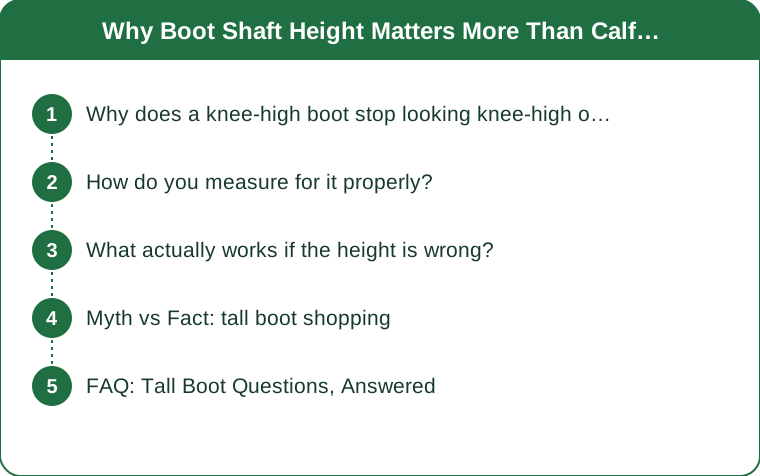
Why does a knee-high boot stop looking knee-high on a tall leg?
Because shaft height is the measurement brands scale least, and on a long leg the shortfall compounds.
Most mainstream boots are graded from a fit block built around a 158–165cm wearer. When they size up, the foot length changes properly, the calf circumference changes a little, and the shaft height often changes by a centimetre or less across the entire size run — sometimes not at all. A boot listed as a 38cm shaft is frequently 38cm in a size 5 and 39cm in a size 9.
Meanwhile, the floor-to-knee distance on a 180cm woman is roughly 8–12cm greater than on a 163cm woman. So the same boot that sits just under the knee on the fit model sits mid-calf on you.
Mid-calf is the widest point of the calf. A horizontal line cutting across the widest point of anything makes that thing read as its widest — this is why the exact same boot looks slim on one person and stumpy on another with a nearly identical calf measurement. It is a line placement problem masquerading as a width problem.
There is a second-order effect too. A shaft that ends at the calf’s widest point has to be wide enough to get over it, so it is cut generously — and then it gapes above, because above the widest point the leg is narrowing away from it. You get the visual of a wide boot and the feel of a loose one, simultaneously, on a leg that is not actually wide.
How do you measure for it properly?
Three measurements, in this order of importance. Take them in the evening, standing, wearing the socks you will actually wear.
1. Floor to knee crease. Stand, find the crease at the back of the knee, measure straight down to the floor. This is the number that decides everything. Your target shaft height is that number minus 4–5cm for a knee-high boot — enough clearance that the top edge does not dig in when you sit, high enough that it reads as knee-high.
For most women over 178cm that target lands between 42 and 46cm. Standard knee-high boots are sold at 36–39cm. That gap is the entire problem, and it is why no amount of calf-width filtering fixes it.
2. Widest calf circumference, and where it sits. Measure the circumference, but also measure the height from the floor to that widest point — usually 30–34cm on a tall leg. Any boot with a shaft height within about 3cm of that number will look wrong on you, regardless of fit. That is the dead zone, and a surprising proportion of mainstream knee-high boots land squarely in it.
3. Ankle and instep. Only relevant for pull-on styles without a zip, but it is the measurement that decides whether the boot goes on at all.
Write all four numbers in your phone. Almost every brand that sells tall or extended-calf boots publishes shaft height per size somewhere in the spec, and the ones that do not are telling you something useful about how much they thought about it.

What actually works if the height is wrong?
Given that genuinely tall-shafted boots are a narrow market, most of the solution is choosing styles where the shaft height is not load-bearing.
Go over the knee rather than fighting for knee-high. An over-the-knee boot on a tall leg reads as a proper OTK boot rather than the thigh-high statement it becomes on a shorter frame — the proportion is flattering and, usefully, the standard OTK shaft height of 48–55cm actually lands correctly on a long leg. This is the single easiest fix and most tall women arrive at it eventually.
Go ankle and mid-calf deliberately, not accidentally. A boot that ends at 20–25cm — a proper ankle boot — creates no awkward horizontal line because it sits below the calf entirely. What does not work is the accidental in-between: a knee-high boot worn as a mid-calf boot.
Slouch styles turn the bug into a feature. A soft unstructured shaft is designed to concertina, so it can be worn pushed down deliberately, and the visual line becomes soft and vertical rather than a hard horizontal cut.
Look at riding and equestrian brands. They cut for a leg that has to fit inside a boot properly and they publish shaft height and calf width as separate spec numbers as a matter of course. Prices are higher; the fit information is dramatically better.
Check the heel height in the same breath. A 4cm heel adds 4cm to the effective distance from floor to knee, which means the same boot reads lower still on you. If you wear heels, measure your target with them on.
Myth vs Fact: tall boot shopping
Myth: Wide-calf is the tall woman’s category. Fact: Wide-calf and tall-shaft are different problems that get bundled together because both are non-standard. Plenty of tall women have slim calves and need a tall narrow shaft, which is the hardest configuration to buy and almost nothing on the high street offers it.
Myth: If the calf fits, the boot fits. Fact: Calf fit determines comfort. Shaft height determines whether it looks right. You can have a perfectly comfortable boot that looks wrong every single time you put it on, and that is the pair that lives at the back of the wardrobe.
Myth: A stretchy shaft solves everything. Fact: Stretch solves width and does nothing for height. Worse, elasticated shafts are usually cut shorter because the stretch panel is expensive — so the stretchy version is often the shortest one in the range.
Myth: You can have boots altered taller. Fact: You cannot add height to a shaft in any way that looks right. You can take a shaft in for width, shorten it, or replace a zip — all routine and worth doing. Adding height means rebuilding the boot.
Myth: Tall sizes just cost more. Fact: They cost more when they exist, but the real issue is that most brands do not grade shaft height at all, so paying more within a mainstream range buys you a better boot at the same wrong height.
FAQ: Tall Boot Questions, Answered
What shaft height should I look for if I am 180cm?
Measure rather than guess, but as a starting point, most women at 180cm need 42–45cm to get a genuine knee-high look. If a listing does not state shaft height, assume it is around 37cm and treat it as mid-calf.
Why do my boots gape at the top even in the right calf size?
Usually because the shaft ends at or just above the widest part of your calf, where the leg is narrowing sharply. The boot was cut wide enough to clear the widest point, so it is now loose everywhere above it. A taller shaft ending below the knee sits in a much more consistent part of the leg.
Are over-the-knee boots too much for everyday wear?
On a long leg they read far more moderately than the photos suggest, because the same shaft height covers a smaller proportion of your leg. Worn with a longer coat and a straight or wide-leg trouser, an OTK boot on a tall frame is closer to a knee-high in effect.
Can I wear tall boots with a midi skirt if I am tall?
Yes, and it is one of the better uses for them — but leave a clear gap of bare leg or opaque tights between the hem and the boot top, rather than letting the two nearly meet. The near-miss is what looks awkward; a definite gap or a definite overlap both work.
TL;DR:
- Brands barely grade shaft height across sizes, so a standard knee-high boot lands at mid-calf on a tall leg.
- Mid-calf is the widest point — a horizontal edge there is what makes the boot look short and the leg look wide.
- Measure floor to knee crease, subtract 4–5cm, and shop that number first; calf width is a comfort question, not a proportion one.
- Over-the-knee, true ankle, and deliberate slouch styles all sidestep the problem entirely.
The pair you keep reaching for will be the one whose top edge sits somewhere your leg is not at its widest — and that is a height decision, not a width one.
Keep Reading
This article is for general informational and styling purposes only. Fit, sizing, and product availability may vary.
