Why Even 'Tall' Activewear Sizing Charts Still Don't Quite Fit Right
Quick Answer: Most “tall” activewear sizing simply adds uniform extra length to a standard pattern rather than adjusting proportions specifically — torso-to-leg ratio varies significantly even among people of the same overall height, so a tall size can still fit poorly if your specific proportion doesn’t match the brand’s assumed tall proportion.
Tall sizing exists as an improvement over standard sizing, but it’s still built around one assumed proportion, and not every tall body matches it.

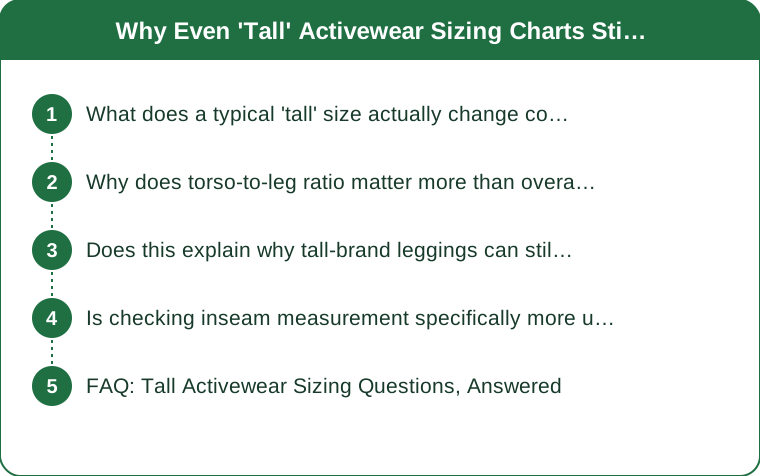
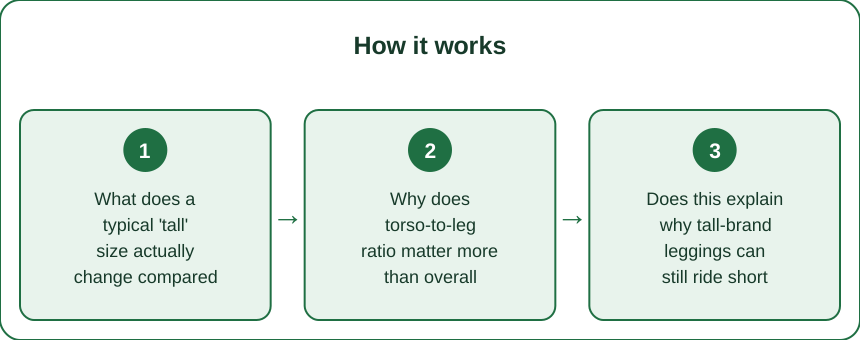
What does a typical ‘tall’ size actually change compared to standard?
Most brands’ tall sizing adds a fixed number of extra inches uniformly to the overall garment length — for leggings, that usually means added inseam; for tops, added torso length — based on an assumed average tall proportion, rather than customizing the ratio between torso and leg length specifically.
Why does torso-to-leg ratio matter more than overall height alone?
Two people can be the same overall height with meaningfully different proportions — one with a longer torso and shorter legs, another the reverse — and a single tall size pattern, built around one assumed ratio, will fit one proportion type well and the other poorly, even though both people are equally “tall” by the height measurement alone.

Does this explain why tall-brand leggings can still ride short on some tall women?
Yes — if a brand’s tall pattern assumes a longer-leg, shorter-torso proportion and a customer actually has a longer torso and proportionally shorter legs relative to their height, the added inseam length benefits a torso-leg ratio that isn’t actually theirs, producing a fit that’s better than standard sizing but still not fully resolved.
Is checking inseam measurement specifically more useful than checking the size label alone?
Generally yes — comparing your own actual inseam measurement against the brand’s stated inseam for that size (when available) is a more reliable predictor of fit than trusting the “tall” label alone, since the label doesn’t communicate which specific proportion assumption the brand built the size around.
FAQ: Tall Activewear Sizing Questions, Answered
Do all brands define ‘tall’ sizing the same way?
No — the added length and the underlying proportion assumption vary meaningfully by brand, which is part of why the same tall size in two different brands can fit quite differently on the same body.
Is it worth measuring your own torso-to-leg ratio before buying tall sizes?
Yes — knowing your own actual inseam and torso length lets you compare directly against a brand’s published measurements rather than relying on the tall label alone, which meaningfully improves the odds of a good first-try fit.
Are petite-tall combination cuts (long torso, shorter leg) available from any brands?
A small but growing number of brands now offer proportion-specific cuts beyond the standard tall/petite binary, which is worth searching for specifically if standard tall sizing consistently doesn’t solve the fit issue.
Does fabric stretch reduce how much the proportion mismatch actually matters?
A higher-stretch fabric can partially compensate for a moderate proportion mismatch, but it doesn’t fully resolve a significant torso-leg ratio difference from the brand’s assumed proportion.
TL;DR:
- Most tall sizing adds uniform extra length rather than adjusting the torso-to-leg ratio itself
- Torso-to-leg proportion varies meaningfully even among people of the same overall height
- A tall size can still underfit if your proportion doesn’t match the brand’s assumed one
- Comparing your actual inseam to the brand’s stated measurement beats trusting the label alone
See It in Motion
Seen here: Super High Waist Embossed Yoga Leggings with Inner Pocket — shop it on bubblelime.com
Keep Reading
This article is for general informational and styling purposes only. Fit, sizing, and product availability may vary.
