Why Mid-Rise Jeans Read as Low-Rise on Tall Women
Quick Answer: Rise is measured as a fixed distance from crotch seam to waistband, not as a position relative to your waist. A 10-inch rise lands at the natural waist on a shorter torso and several inches below it on a longer one. Tall women usually need to shop one rise category up — buy high-rise to wear mid, and mid to wear low — and check the front rise number rather than the marketing label.
The tag is not lying. It is describing the garment, and you were hoping it would describe you.

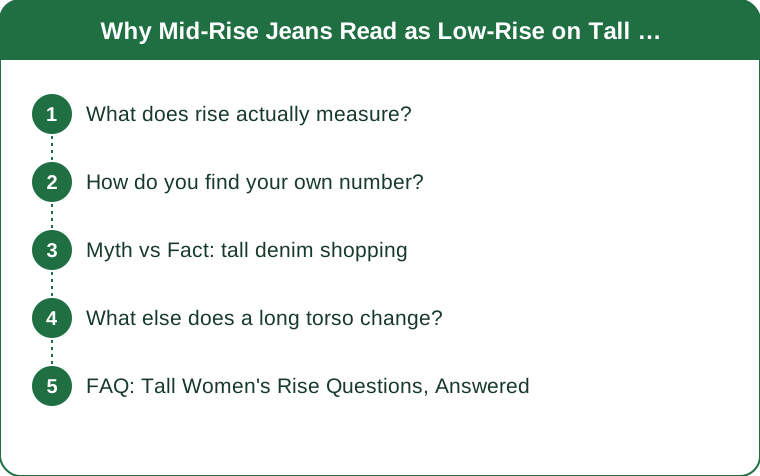
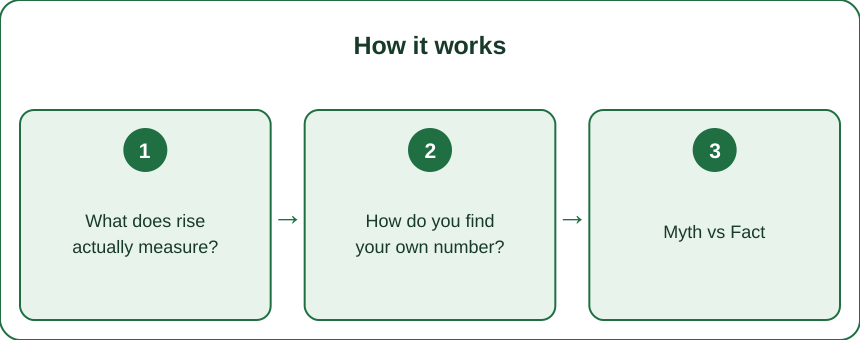
What does rise actually measure?
The vertical distance from the crotch seam to the top of the waistband at the front. That is it.
That number tells you nothing about where the waistband will sit, because where it sits depends on the length of your torso below the waist — specifically the distance from your own crotch to your natural waist.
A worked example. Say a brand labels a 10.5-inch front rise as “mid-rise.” That label assumes a fit model whose crotch-to-waist distance is about 12 inches, so the waistband sits an inch and a half below her natural waist — genuinely mid-rise.
If your crotch-to-waist distance is 14 inches, that same 10.5-inch rise sits three and a half inches below your natural waist. On you it is a low-rise, and it will behave like one: sliding down when you sit, gapping at the back, and cutting across the widest part of the hip instead of the narrowest part of the waist.
The important part: height mostly lives in the legs, but not entirely. A tall woman typically has both a longer inseam and a longer torso, and the torso portion is what breaks rise labels. Two women of the same height can have quite different rise needs depending on where their height sits.
How do you find your own number?
Measure once and you will never guess again.
Measure your crotch-to-waist distance. Sit upright on a hard chair. Measure from the chair surface up the side of your body to your natural waist — the narrowest point, usually just above the navel. That is your seated rise. It runs a little longer than the flat measurement of a garment, so treat it as a reference rather than a target you match exactly.
Better: measure a pair that already fits. Take jeans you like the sit of, lay them flat, button them, and measure from the crotch seam straight up to the top of the waistband at the front. That number is your target front rise. Write it down.
Then shop by that number. Most denim brands publish front rise in the product specs even when the label just says “mid.” If it is not listed, it is worth a question to customer service — the number exists, it is just not on the marketing copy.
Typical targets: many tall women land around 11 to 12.5 inches for a true mid-rise wear and 12.5 to 14 for a high-rise wear, versus the 9 to 11 inches that standard sizing treats as mid. Your number is your number; the point is that it is probably one full category above what the label says.

Myth vs Fact: tall denim shopping
Myth: Buying a longer inseam solves tall fit.
Fact: Inseam solves length. It does nothing for rise, and rise is what determines whether the jeans stay up, whether the back gaps, and whether the waistband sits at your narrowest point. Many tall women get the length right and stay frustrated for years because the actual problem was three inches higher.
Myth: Tall-specific lines fix everything.
Fact: They help, but many tall ranges only extend the inseam and leave rise unchanged. Check the spec sheet against the regular version — if the front rise is identical, the tall line is a longer leg on a standard body, and it will fit the same way at the waist.
Myth: A gapping back waistband means you need a smaller size.
Fact: Sometimes. But a gap that appears specifically when you sit or bend, on jeans that fit fine at the hip, is usually a rise problem — the waistband is sitting at a point on your body where the front-to-back difference is larger than the garment was drafted for. Sizing down makes the hip too tight and does not fix the gap.
Myth: High-rise is a trend you can wait out.
Fact: For a long torso, high-rise on the tag is functionally mid-rise on the body. It is not a style commitment, it is a measurement correction — which is why tall women often keep wearing high-rise regardless of what the season is doing.
What else does a long torso change?
Rise is the headline, but the same measurement quietly affects several other things.
Where a shirt hem lands. A tuckable top designed to hit a few inches below the natural waist will hit at or above your waistband, which is why so many tops seem to end at exactly the wrong place. Look for hem-to-shoulder length in specs, and treat “cropped” as unwearable-as-photographed.
Bodysuits and one-pieces. These fail on total torso length, not on size. A bodysuit sized for your bust and hips can still be several inches short through the body, which shows up as a pulling sensation at the shoulders. Look for brands that publish a torso length or offer a long option.
Where a belt sits and what it does. If the waistband is below your natural waist, a belt at the waistband cuts the body at the hip line rather than the waist, which visually shortens the leg. This is the mechanism behind the common feeling that a belt “does nothing” on a tall frame.
Jumpsuits. The single most rise-sensitive garment there is, because the rise error compounds with the bodice length. Almost always needs a tall or long-torso version, not just a longer leg.
FAQ: Tall Women’s Rise Questions, Answered
Can a tailor fix rise?
Not really — raising a rise means reconstructing the crotch seam and the entire waistband, which is expensive and rarely comes out well on denim. Taking in a waistband is easy; changing rise is not. Buy the rise, alter the waist.
Should I just buy men’s jeans for the longer rise?
Men’s denim often does have a longer rise for the same waist, and some tall women find it works. The trade-off is hip-to-waist ratio — men’s patterns are drafted with a much smaller difference between waist and hip, so if you have a defined waist you will get gapping at the back. Worth trying, not a universal fix.
Why do the same-labeled jeans from one brand fit and another does not?
Because each brand drafts to its own fit model, and rise varies by more than two inches across brands at the same label. This is exactly why the specification number is worth more than the category name — the number is comparable across brands, the word is not.
TL;DR:
- Rise is a fixed distance on the garment, not a position on your body.
- A long torso pushes every rise label one category down: buy high to wear mid.
- Measure the front rise of jeans that already fit and shop that number, not the marketing word.
- Tall lines often extend the inseam only — check whether the rise actually changed.
- Rise problems also explain awkward top hems, short bodysuits and useless belts.
Once you know your front rise number, denim shopping goes from a guessing game to a filter. It is one measurement, and it fixes the thing that inseam never could.
Keep Reading
This article is for general informational and styling purposes only. Fit, sizing, and product availability may vary.
