When the Gym Machine Runs Out of Adjustment Before You Fit
Quick Answer: Most selectorised machines are designed around roughly a 5th-to-95th percentile range built on mixed-population data, which in practice means a woman over about 178cm runs out of adjustment on several common machines — usually the lat pulldown thigh pad, the leg extension back pad, the chest press seat and the preacher curl. When a machine cannot be set to put the joint at the pivot, the fix is to change the machine or the attachment, not to force the position.
You pull the pin to the last hole and it is still not far enough. So you use it anyway, slightly folded, and wonder why your lower back is annoyed afterwards.
It is not your form. It is a range-of-adjustment problem, and it has specific solutions.
Which machines actually run out first?
The pattern is consistent, and knowing it lets you plan a session rather than discover it mid-workout.
Lat pulldown thigh pads are the most common failure. The pads are designed to trap your thighs, and on long femurs the highest setting still presses down uncomfortably or the lowest setting leaves you floating. Floating is the worse of the two — without anchoring, you pull yourself off the seat and the movement turns into a partial pull-up.
Leg extension and leg curl back pads frequently do not slide far enough back. With long femurs, your knee sits in front of the machine’s pivot, which means the resistance arm is not rotating around your knee joint. That mismatch loads the knee in shear rather than rotation, and it is the version of this problem most likely to actually hurt.
Chest press and shoulder press seats run out at the bottom. If the seat cannot go low enough, the handles sit above mid-chest and the press becomes an incline at an angle you did not choose. Long arms compound it, because you are also travelling further than the machine’s stroke was designed for.
Preacher curl benches are almost universally too small — the pad length is fixed and the armpit position that works for an average torso puts a tall woman’s elbows off the end.
Seated row chest pads stop short, leaving you reaching forward past the pad rather than braced against it.
Rowing machines and ellipticals are the cardio equivalents: the rower is fine, but the elliptical stride length is fixed on cheaper units and a stride shorter than yours forces a shuffling gait that irritates hips over time.
What generally works fine: cable stacks of any kind, free weights, the hip thrust, most plate-loaded machines with independent arms, and anything where you set your own position rather than being placed by a pad.
Why does a bad fit actually matter?
Because the entire point of a selectorised machine is that its pivot replaces your joint’s pivot. When those two do not line up, the machine stops doing what it was built to do.
The pivot mismatch changes the resistance curve. A leg extension is designed so that the cam applies most resistance where your quadriceps is strongest. Sit with your knee 5cm forward of the pivot and that relationship breaks — the strength curve no longer matches the resistance curve, and load lands in the wrong part of the range.
It converts rotation into shear. A knee rotating around a point that is not its own axis gets pushed as well as turned. Over a set that is tolerable. Over months it is the mechanism behind the vague front-of-knee ache that tall lifters report from leg extensions and never from squats.
Range of motion silently shrinks. If the seat is too high on a chest press, the handles never reach your chest and you are training a partial rep at a joint angle you did not select. Progress stalls and the reason is invisible in your logbook.
Stabilisers take over. Sit unanchored on a lat pulldown and your abdominals and hip flexors work to hold you down. That is not inherently bad, but it means the lat is no longer the limiting factor and the weight you can move stops reflecting back strength.
Compensation moves up the chain. The most common visible sign is lumbar extension — arching to reach a handle that is too high or too far. That is where tall lifters most often pick up nagging low-back irritation from machines, and it is entirely a fit problem rather than a strength one.
And it dents adherence more than people admit. Spending five minutes fighting a machine that will not fit, in a busy gym, with people waiting, is a genuine reason tall women drift away from machine-based programmes. That is worth naming rather than treating as a character issue.
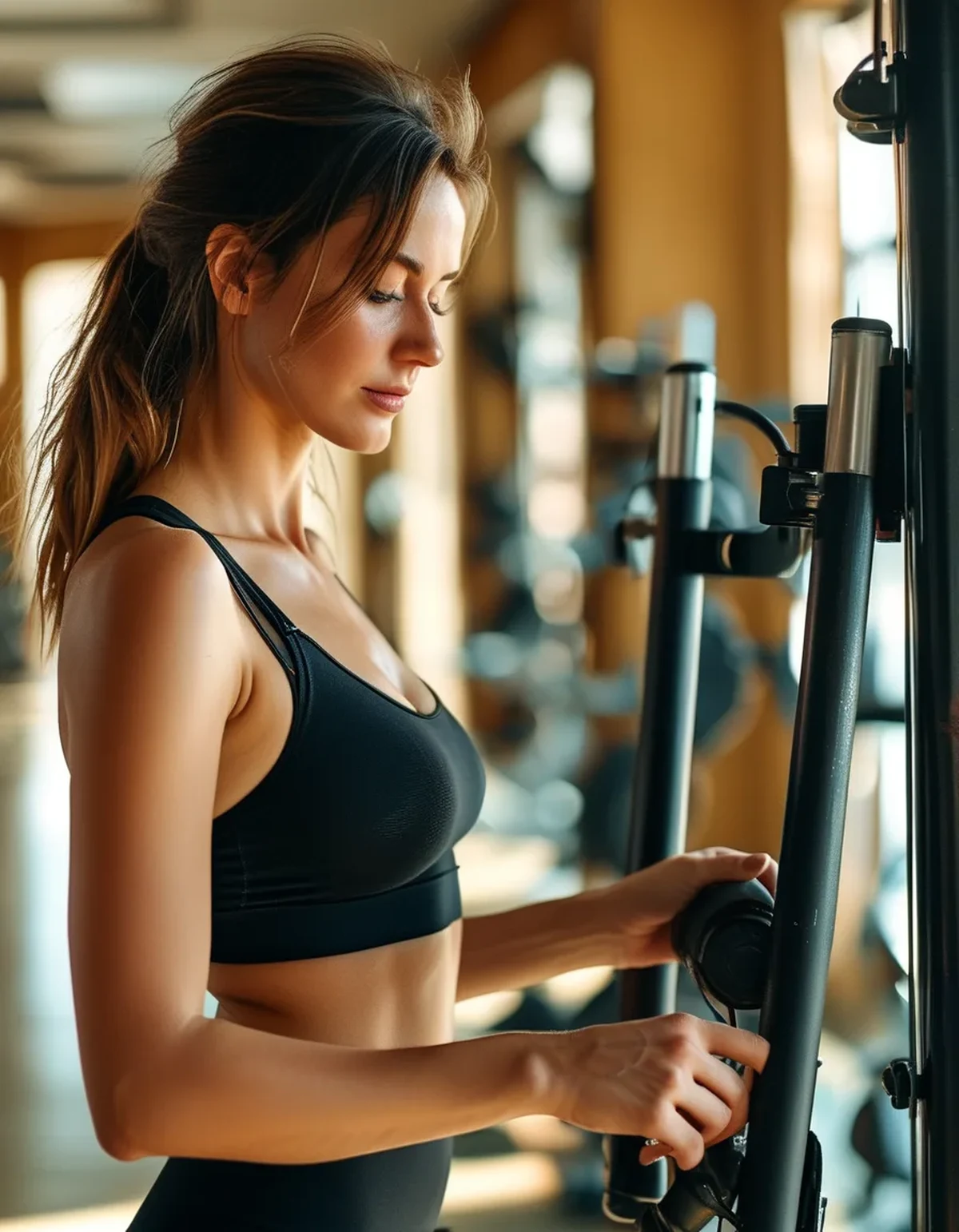
5 Workarounds That Actually Work
1. Add height rather than chasing the seat. If a seat cannot go low enough relative to the handles, you cannot lower the seat — but you can raise yourself out of the problem on machines where the issue is reach rather than height, using a folded mat or a plate under the feet to restore a braced position. On a seated row or chest press, a solid foot platform often fixes the whole thing, because most of the discomfort comes from feet dangling with no base.
2. Swap the machine for its cable version. Almost every fixed machine has a cable equivalent: lat pulldown to a kneeling or standing cable pulldown, chest press to a cable press, leg curl to a standing single-leg curl. Cables have no fixed pivot, so there is nothing to mismatch. For a tall lifter this is not a compromise — it is usually the better exercise.
3. Use the plate-loaded machines instead of the selectorised ones. Plate-loaded machines with independent arms typically have longer travel and more generous seat ranges, because they are built for heavier and larger users. If your gym has both, default to those.
4. Reset the pad, not your body. On lat pulldowns where the thigh pad is too high, sit further forward on the seat rather than sliding under the pad. On seated rows where the chest pad is too far away, sit on a folded towel to raise your torso rather than rounding forward to reach it. Small positional changes recover a surprising amount of range.
5. Take the pin out and test empty first. Set the machine with no weight and move through the full range once before loading it. Thirty seconds spent here tells you whether the machine fits at all, and it is far less awkward than discovering the problem on your second working set with someone waiting. Note the settings that do work in your phone — for the machines that fit, you never have to solve it again.
What should a tall woman’s machine session look like?
Built around the equipment that adjusts, rather than fighting the equipment that does not.
Lead with cables and free weights, use machines as accessories. This is the structural answer. A programme built on squats, hinges, presses and rows with a barbell or dumbbells does not have a fit problem at all, because you set every position yourself. Machines then fill in as isolation work where they happen to fit.
Choose the machines that are forgiving. Hip thrust machines, glute kickback cables, most chest-supported row variants with adjustable pads, and any machine with an adjustable-height cable origin will generally accommodate you.
Substitute predictably. Leg extension becomes a slow tempo split squat or a Bulgarian split squat. Leg curl becomes a Nordic curl or a stability ball curl. Preacher curl becomes an incline dumbbell curl, which is arguably better for long arms anyway. Chest press becomes a dumbbell press on an adjustable bench, where you control the angle.
Expect to use a lower absolute weight on some lifts. Long limbs mean a longer lever arm, which means more torque required for the same load. This is physics, not weakness, and comparing your numbers to a shorter training partner’s on a lift with a long moment arm is comparing two different problems.
Adjust before every set, not just at the start. Machine settings drift as other people use them, and re-checking the pin position takes three seconds. This is worth building as a habit rather than an afterthought.
If the gym is genuinely unequipped, say so. Gyms do replace equipment, and staff are usually unaware that a machine has a fit ceiling because nobody mentions it. A specific request — the leg extension back pad does not travel far enough for taller members — is far more actionable than a general complaint, and larger-range machines exist.
Seasonally, this is worth sorting now. Autumn is when outdoor training moves indoors and gyms get busy, which means less time to fiddle with settings and more pressure to just use whatever is free. Knowing your three go-to substitutions in advance means a packed gym floor does not derail the session.
FAQ: Tall Women and Gym Equipment, Answered
Is there a height where machines just stop working?
It varies by manufacturer, but problems become common from around 178cm and near-universal past about 185cm, particularly for anyone with a long femur relative to their height. Limb proportion matters as much as total height.
Should I avoid machines entirely?
No. Plenty fit fine, and machines are genuinely useful for isolation and for training close to failure safely. The point is to select rather than to accept whatever is in the circuit.
Why do my knees hurt on the leg extension but not squatting?
Most likely because your knee is not aligned with the machine’s pivot, which loads the joint in shear. Squats have no external pivot to mismatch. If the back pad will not travel far enough, substitute rather than persist.
Do I need to lift lighter because I am tall?
On long-lever lifts, the same muscular force produces less external load, so your numbers on some lifts will be lower than a shorter lifter’s at equal strength. That is geometry. It does not mean you should train lighter — it means the number is not the metric.
Are commercial gyms better or worse than boutique studios for this?
Larger commercial gyms usually win, because they carry both selectorised and plate-loaded lines plus more cable stations. Boutique studios with a single fixed circuit are the hardest environment.
Is there anything to check before joining a gym?
Walk the floor and sit on three machines — lat pulldown, leg extension, chest press. If all three adjust to fit, the rest of the equipment almost certainly will too. Fifteen minutes on a trial visit saves a year of frustration.
TL;DR:
- Machines fail for tall women at the thigh pad, back pad, seat height and preacher pad — predictably, and in that order.
- A pivot that does not match your joint changes the resistance curve and loads the knee in shear, which is the version that actually hurts.
- Cables and plate-loaded machines have no fixed pivot to mismatch — for a tall lifter they are usually the better choice, not a compromise.
- Test the range empty before loading, and save the settings that work in your phone.
- Longer levers mean lower numbers on some lifts. That is geometry, not weakness.
Pick three reliable substitutions now, before the autumn gym rush makes fiddling with pins impossible.
Keep Reading
This article is for general informational and styling purposes only. Fit, sizing, and product availability may vary.
